UV printing (ultraviolet printing) is a modern digital printing process in which special inks are immediately cured chemically by ultraviolet light. Since the inks do not penetrate the material but instead cure on the surface, virtually all flat or curved materials can be printed directly and with brilliant quality.
In UV digital printing, the ink is applied directly from the print head onto the material. Immediately after ink application, powerful LED-UV lamps cure the ink in fractions of a second - not through evaporation, but through light. The ink fills pores and microstructures and forms a closed layer on the material surface. Scratch-resistant, weatherproof, and immediately ready for further processing. The process works on virtually all materials - from sheet materials such as PVC, acrylic, aluminium, wood, and glass to textiles and flexible films.
Material versatility:
PVC, acrylic, aluminium, wood, and even textiles. One printing process, many substrates.
Brilliant sharpness:
Fine lines, crisp typography at small font sizes, clean edges.
Immediately ready for further processing:
No drying time - finishing and laminating without waiting.
Brilliant in backlit applications:
The ideal basis for backlit light frames such as LEDUP, BIGLEDUP, or LINEUP.
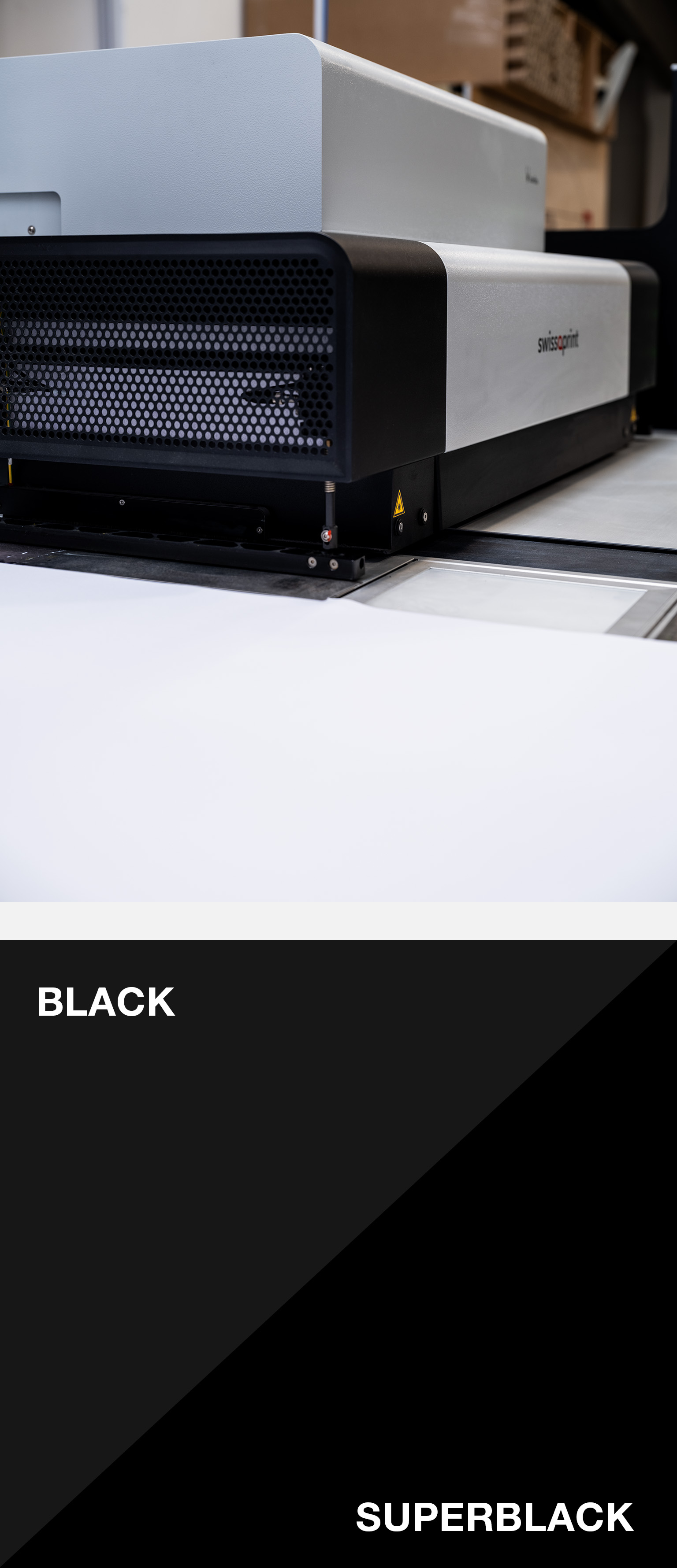
Superblack:
UV printing produces a rich, deep black with exceptional opacity - ideal for high-contrast logos, typography, and graphics that make an impact from a distance at trade shows.
Note: Printed textiles must be transported rolled, as otherwise visible crease marks will appear in the print.
Ink Application
The print head moves over the material and applies liquid UV ink with microfine precision, dot by dot.
UV Exposure
Directly behind the print head sits a UV-LED lamp that travels in sync and immediately exposes the fresh ink.
Curing
The UV light triggers a chemical reaction. The liquid ink bonds within milliseconds into a robust plastic layer that is permanently scratch-resistant and durable.
UV digital printing is the ideal solution when maximum precision, high contrast, and immediate availability are required. The process truly excels with motifs featuring very fine lines, small typography, and strong black elements.
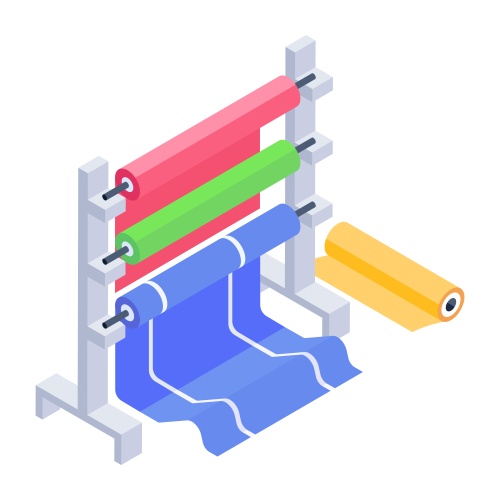
Sublimation direct printing is a thermal printing process in which the ink does not sit on the surface but instead becomes gaseous under heat and penetrates deep into the fibres of the material. The ink bonds permanently with the material, resulting in extremely durable, scratch-resistant, and wash-resistant print results.
With sublimation, the motif is printed directly onto polyester fabric and fixed under approximately 200 °C in a calender press. The pigments transfer molecularly into the fibre. The ink sits within the material and stays there.
Crease-free and foldable:
No visible crease marks, even after multiple transports.
Compactly foldable and therefore compactly packable.
Brilliant in backlit applications:
The ideal basis for backlit light frames such as LEDUP, BIGLEDUP, or LINEUP.
Washable* and reusable:
One motif, many applications.
* 30 degrees, without detergent, gentle cycle, no spin.
Caution: Washing removes the flame-retardant coating (B1 coating).
Note: For production-related reasons, the printed fabrics must rest for at least 24 hours after the calendering process before they can be further processed. After printing, moisture slowly returns to the material, which is essential for uniform processing and high dimensional stability.
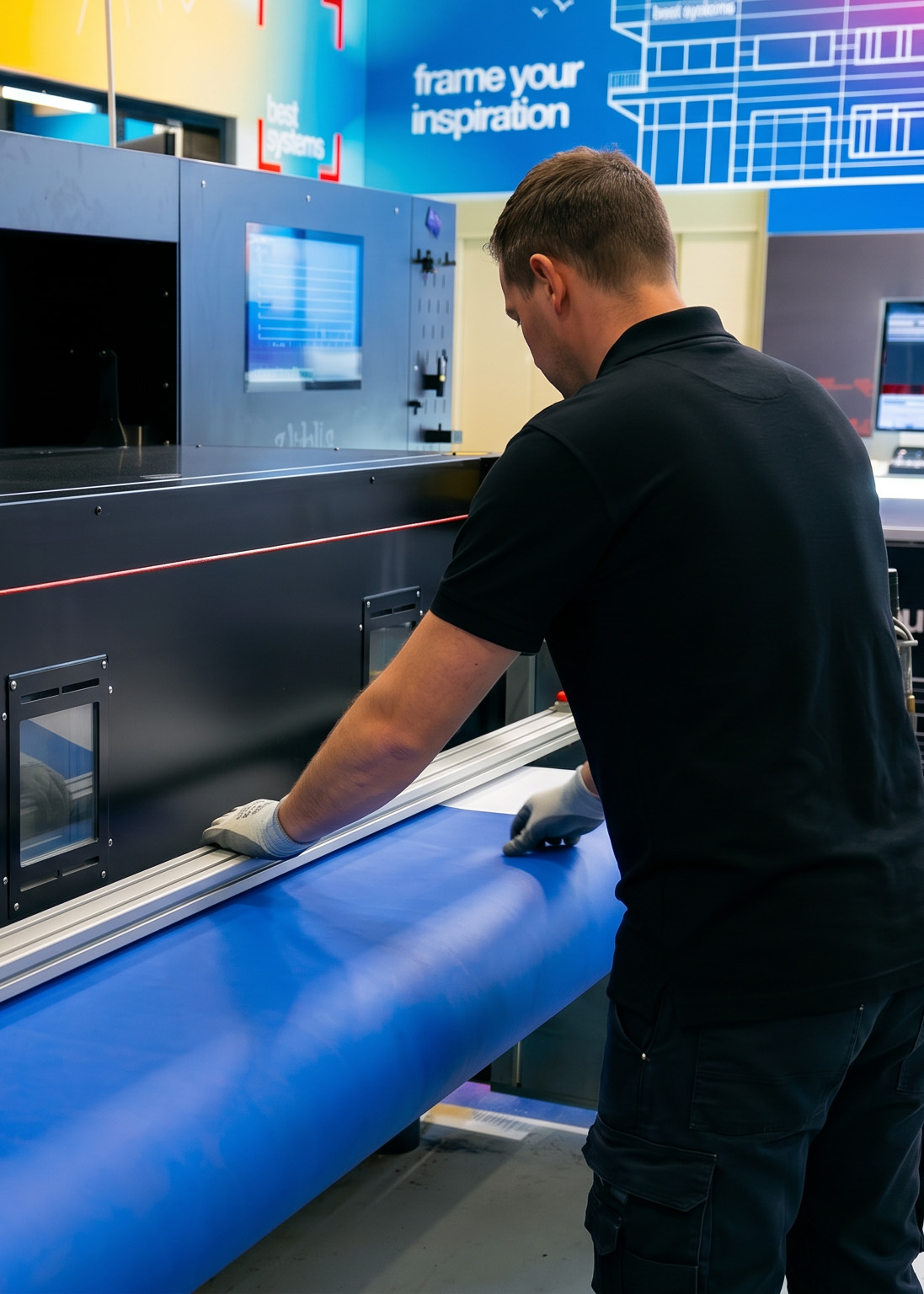
Direct Application
The print head sprays the liquid, sublimation-capable ink directly onto the specially pre-treated textile. The ink initially adheres to the surface of the fibre.
Fixation - directly in the printing machine
The textile immediately continues through an integrated heat unit - a fixation unit. At temperatures of 80–100 °C and high pressure, the colour pigments are activated and pressed into the upper layers of the textile.
Final Fixation in the Fibre
In the final step, the material passes through an external calender. Under high temperatures of 180–200 °C and pressure, it is guided over a series of rollers. Through heat and pressure, the ink transitions from a solid to a gaseous state and penetrates deep into the fibres. This is where the ink receives its final fixation and its permanent place deep within the fibre of the print material. This step is decisive for the colour depth and brilliance of the print.
Resting Phase - 24-Hour Acclimatisation
After the ink has been introduced into the fibre, the textile needs time to cool down. During this time, the ink bonds permanently with the material. The material is stored for 24 hours and can slowly reabsorb moisture during this period. The internal structure of the fabric has been subjected to heat and pressure and has the opportunity to stabilise during this time. Only after this resting phase has the textile reached its final shape, tension, and dimensional stability. This step is decisive for consistent quality and precise further processing.
Sublimation printing is the optimal choice when flexibility, mobility, and durable textile applications are the priority. With the ink embedded deep within the fibre, crease-free, washable, and reusable prints are produced that are ideally suited for frequent use at trade shows..

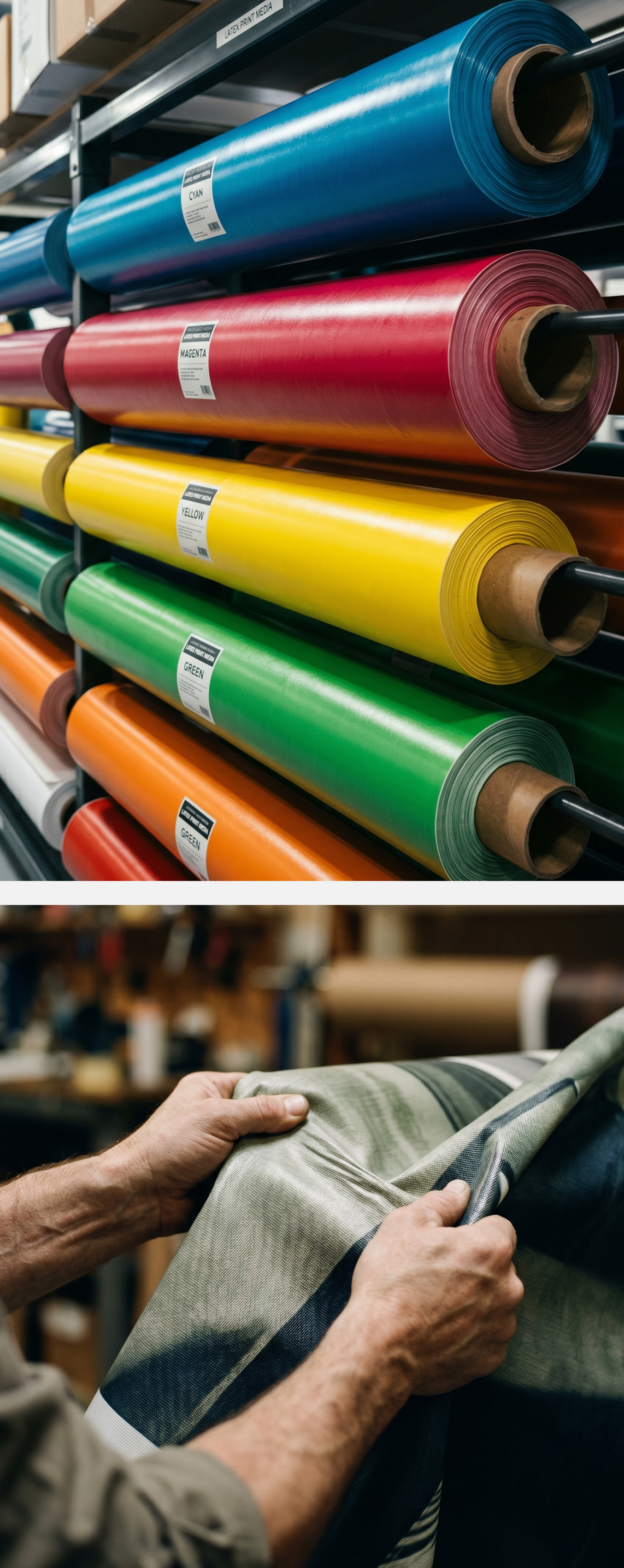
Latex printing is a water-based inkjet process in which colour pigments and latex polymers are applied together to the material and cured by heat into a stable, elastic layer. No solvents, no off-gassing - the print leaves the machine dry and immediately ready for further processing.
Latex printing is a multi-stage printing process in which the colour pigments are first fixed, then applied with precision, and subsequently fused by heat into a durable, flexible surface. This results in detailed, durable, and versatile print outcomes.
Material versatility:
PVC films, self-adhesive films, backlit films, paper, and textiles. One printing process, many substrates.
Immediately ready for further processing:
No off-gassing, no waiting. The print medium leaves the machine completely dry and can be laminated, cut, packaged, or mounted immediately.
Flexible & tear-resistant:
The elastic latex film is resistant to mechanical stress and remains stable and intact even when rolled.
Colour accuracy & brilliance:
Vivid colours, rich blacks, and a consistent print image.
Laminatability:
Lamination effectively protects prints from mechanical influences, UV radiation, and weathering, significantly extending their lifespan. At the same time, it enhances the appearance, facilitates cleaning, and enables additional functions such as anti-slip properties or increased chemical resistance.
Flexibly combinable:
Latex prints can easily be laminated onto rigid materials such as acrylic, Dibond, or Forex using self-adhesive films, combining the flexibility of the printing process with the stability of solid substrates.
Note: Latex printing works exclusively with roll-based materials — rigid boards cannot be printed directly with this process. This printing process is not used for our fabric prints, as the ink merely sits on the surface rather than penetrating the fibre as with sublimation printing, and the ink density is not as high as with UV printing.
Fixation
First, a transparent optimizer is applied. It immediately fixes the colour pigments at their exact position on the material - no bleeding, no blurred edges, even at high print speeds.
Ink Application
The print heads apply the ink in the tiniest droplets with microfine precision - accurately, dot by dot. The result: sharp text, clean contours, and brilliant colour gradients.
Curing
In the integrated heating unit, the water in the ink evaporates completely. The latex particles melt and form a robust, elastic polymer film that is scratch-resistant, flexible, and permanent.
Latex printing is the ideal choice when versatility, fast further processing, and consistently high-quality results are the focus. The water-based, instantly drying ink enables efficient production without waiting times and delivers robust, colour-intensive prints with high flexibility. Thanks to the broad range of compatible materials as well as the option for lamination and mounting, the process is excellently suited for durable indoor and outdoor applications.

WARNING: By using the website, the user agrees to comply with all the provisions in the following general terms of use for the content of the website best-systems.com.
By visiting the website or subscribing to the newsletter, the user agrees to the general terms of use. If the user does not agree with the general terms of use, the use of the website or subscription to e-newsletters and filling out forms on the site is not possible.
General Provisions
The general terms of use (hereinafter: terms of use) of the website best-systems.com (hereinafter: website) relate to the terms of use of the content on the website. They represent a legally valid and binding agreement between Best Systems GmbH, Siebenhirtenstraße 12A Object 5, 1230 Vienna (hereinafter: provider), and each person who visits the website and/or uses the website in any way (hereinafter: user).
The provider reserves the right to change and/or delete any part of the websites without prior notice. With the aim of providing the user with the best possible experience, the provider ensures continuous updating of the website. The user is aware and agrees that the format and nature of the website may change occasionally without prior notice to the user.
Website Accessibility
The websites are generally accessible 24 hours a day. The provider reserves the right to temporarily interrupt access to the websites for technical reasons. The provider also reserves the right to longer interruptions of access to websites in cases related to maintenance work and/or equipment replacement. The provider does not guarantee access to the websites in cases of outages in internet connection provider networks or any outages, errors, and/or other technical disruptions or interruptions resulting from the non-functioning of third parties (internet connection outage, power outage, etc.) and in cases of force majeure.
Limitations of Access to Websites
The provider reserves the right, in case of suspected abuse as stated in point 7 of these terms of use, to restrict or terminate access to website content for an individual user's IP address.
Age Restrictions and Liability
There are no age restrictions for using the websites. The use of websites is intended for personal use by the user. Registering other persons or filling out forms for other persons is not allowed, for which the user guarantees with full indemnity liability and assumes passive legitimation in case of disputes.
To view more details about privacy policy and cookies policy, please visit the following links:
Privacy policy
Personal data protection policy
Disclaimer
The user acknowledges that:
Without prior permission from the provider, it is prohibited to: copy, print, or store published images on websites. Similarly, without prior permission from the provider, the use of graphical elements and trademarks is expressly prohibited.
Use of AI-Generated Content
The Provider uses images, graphics, renderings, and visualizations on this website that may be created or enhanced with the assistance of artificial intelligence (AI). These materials are intended solely for the illustration, presentation, and marketing of the Provider's products and services.
Unless explicitly stated otherwise, AI-generated visualizations do not constitute a binding representation of actual products, projects, or installations. The specifications, features, scope of delivery, and performance of the products offered are governed exclusively by the respective product descriptions, technical data sheets, and individual quotations provided by the Provider.
The user agrees:
Complaints
In case of issues or questions, you can send a message to office@best-systems.com.
Violation of Terms of Use
The provider reserves the right to disable access to websites for users who violate terms of use or general business terms. If a user causes any damage to the provider through their actions, they are fully morally, materially, and criminally liable. Any violations of business terms and/or general business terms by other users can be reported to office@best-systems.com.
Changes and Amendments to General Terms of Use
The provider may change and/or amend these terms of use due to changes in regulations governing website operations, data protection, and other areas related to the provider's website operations and changes in their own business policy. Users will be informed about these changes through suitable means every time they occur, especially through notifications on the website https://www.best-systems.com or via email, especially if changes concern changes in personal data protection policy. Each change and/or amendment to terms of use will come into effect with an eight-day period after publication. If changes and/or amendments to business terms are necessary for compliance with regulations, these changes may exceptionally come into effect in a shorter period.
Users who do not agree with changes and/or amendments to these terms of use must cancel their registration within eight days of notification about changes and/or amendments to terms of use or stop using services, content, or anything else from websites; otherwise, after this period expires, it will be considered that the user accepts changes and/or amendments to terms of use. Registration cancellation is done by sending a written statement to the provider. Ceasing use is considered when a user no longer uses the provider's websites in any way.
The general business terms were adopted by the provider's director in Vienna on January 22nd, 2025.
WARNING: By using the website, the user agrees to comply with all the provisions in the following general terms of use for the content of the website best-systems.com.
By visiting the website or subscribing to the newsletter, the user agrees to the general terms of use. If the user does not agree with the general terms of use, the use of the website or subscription to e-newsletters and filling out forms on the site is not possible.
General Provisions
The general terms of use (hereinafter: terms of use) of the website best-systems.com (hereinafter: website) relate to the terms of use of the content on the website. They represent a legally valid and binding agreement between Best Systems GmbH, Siebenhirtenstraße 12A Object 5, 1230 Vienna (hereinafter: provider), and each person who visits the website and/or uses the website in any way (hereinafter: user).
The provider reserves the right to change and/or delete any part of the websites without prior notice. With the aim of providing the user with the best possible experience, the provider ensures continuous updating of the website. The user is aware and agrees that the format and nature of the website may change occasionally without prior notice to the user.
Website Accessibility
The websites are generally accessible 24 hours a day. The provider reserves the right to temporarily interrupt access to the websites for technical reasons. The provider also reserves the right to longer interruptions of access to websites in cases related to maintenance work and/or equipment replacement. The provider does not guarantee access to the websites in cases of outages in internet connection provider networks or any outages, errors, and/or other technical disruptions or interruptions resulting from the non-functioning of third parties (internet connection outage, power outage, etc.) and in cases of force majeure.
Limitations of Access to Websites
The provider reserves the right, in case of suspected abuse as stated in point 7 of these terms of use, to restrict or terminate access to website content for an individual user's IP address.
Age Restrictions and Liability
There are no age restrictions for using the websites. The use of websites is intended for personal use by the user. Registering other persons or filling out forms for other persons is not allowed, for which the user guarantees with full indemnity liability and assumes passive legitimation in case of disputes.
To view more details about privacy policy and cookies policy, please visit the following links:
Privacy policy
Personal data protection policy
Disclaimer
The user acknowledges that:
Without prior permission from the provider, it is prohibited to: copy, print, or store published images on websites. Similarly, without prior permission from the provider, the use of graphical elements and trademarks is expressly prohibited.
Use of AI-Generated Content
The Provider uses images, graphics, renderings, and visualizations on this website that may be created or enhanced with the assistance of artificial intelligence (AI). These materials are intended solely for the illustration, presentation, and marketing of the Provider's products and services.
Unless explicitly stated otherwise, AI-generated visualizations do not constitute a binding representation of actual products, projects, or installations. The specifications, features, scope of delivery, and performance of the products offered are governed exclusively by the respective product descriptions, technical data sheets, and individual quotations provided by the Provider.
The user agrees:
Complaints
In case of issues or questions, you can send a message to office@best-systems.com.
Violation of Terms of Use
The provider reserves the right to disable access to websites for users who violate terms of use or general business terms. If a user causes any damage to the provider through their actions, they are fully morally, materially, and criminally liable. Any violations of business terms and/or general business terms by other users can be reported to office@best-systems.com.
Changes and Amendments to General Terms of Use
The provider may change and/or amend these terms of use due to changes in regulations governing website operations, data protection, and other areas related to the provider's website operations and changes in their own business policy. Users will be informed about these changes through suitable means every time they occur, especially through notifications on the website https://www.best-systems.com or via email, especially if changes concern changes in personal data protection policy. Each change and/or amendment to terms of use will come into effect with an eight-day period after publication. If changes and/or amendments to business terms are necessary for compliance with regulations, these changes may exceptionally come into effect in a shorter period.
Users who do not agree with changes and/or amendments to these terms of use must cancel their registration within eight days of notification about changes and/or amendments to terms of use or stop using services, content, or anything else from websites; otherwise, after this period expires, it will be considered that the user accepts changes and/or amendments to terms of use. Registration cancellation is done by sending a written statement to the provider. Ceasing use is considered when a user no longer uses the provider's websites in any way.
The general business terms were adopted by the provider's director in Vienna on January 22nd, 2025.